
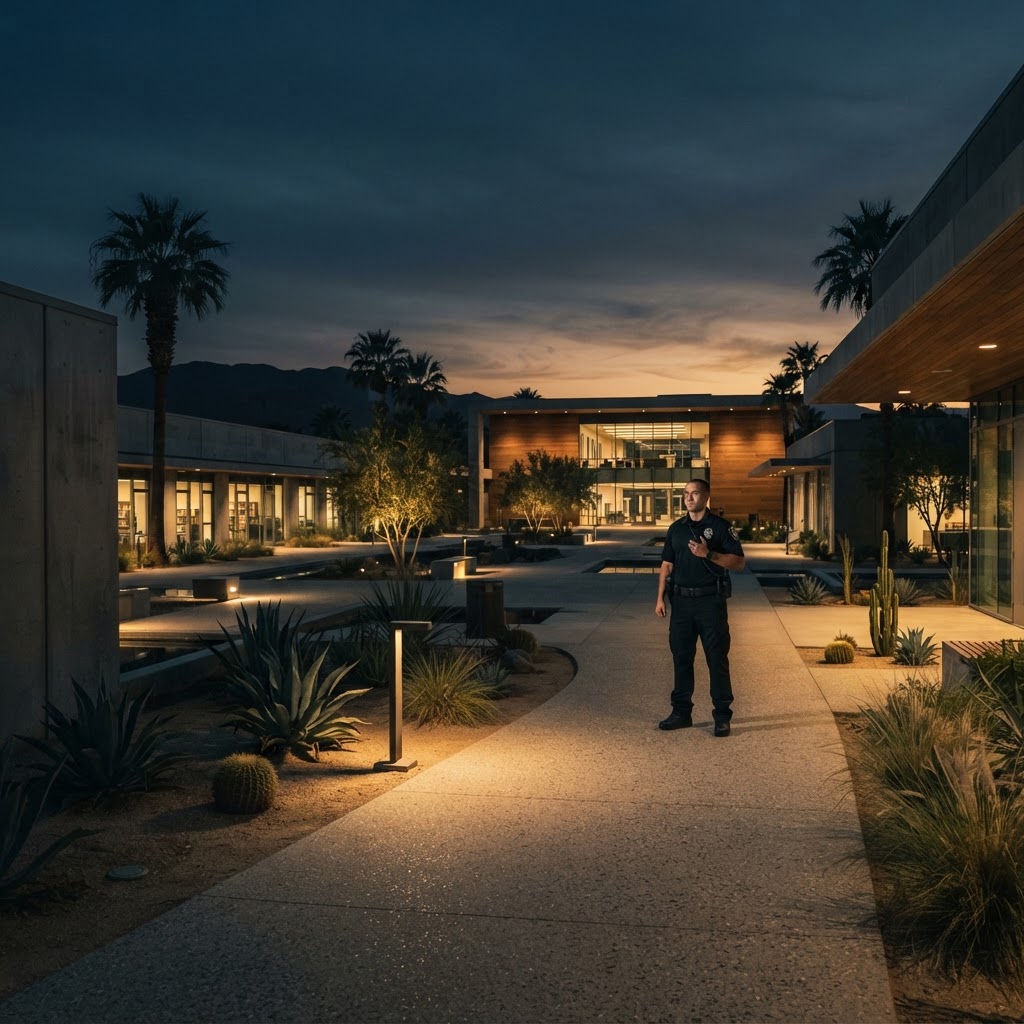
Educational institutions have long stood as sanctuaries of discovery, personal growth, and community gathering. However, as 2026 unfolds, campus environments across the nation face a complex convergence of challenges: grievance-driven disruptions, modern access-control vulnerabilities, digital-era behavioral risks, and heightened community expectations for safety. From private prep academies in Palm Desert to regional learning centers spanning Cathedral City, Indio, and Thermal, the security landscape surrounding education requires a strategic departure from outdated paradigms.
Historically, institutional safety was often treated as an exercise in gate-keeping or passive perimeter observation. Today, an effective campus protection framework demands an integrated, human-centric approach that blends advanced threat assessment, specialized physical presence, and discreet concierge-level professionalism.
The Changing Threat Horizon on Modern Campuses
Recent industry analyses highlight that campus environments are increasingly vulnerable to external friction spilling onto institutional grounds. Across California, public school districts, private academies, and collegiate annexes are managing polarized public discourse, unauthorized access attempts, and volatile disputes that can escalate rapidly if left unaddressed.
Moreover, the nature of campus operations—characterized by open architecture, dynamic vehicle and pedestrian circulation, and frequent public-facing athletic and cultural events—demands solutions that avoid creating a fortified or intimidating atmosphere. Educational leaders cannot simply wall off their grounds. Protection must operate as an invisible shield: highly capable, technically sophisticated, yet welcoming to students, faculty, and visiting families.
Integrating Intelligent Access and Threat Mitigation
Modern educational protection rests on layered defense and early intervention. The most successful security programs do not wait for an incident to breach a classroom threshold; they identify anomalies long before they manifest into active crises.
First, access control must function as a seamless operational continuum. Integrating visitor verification, digital credentialing, and discreet automated perimeter monitoring allows institutions to manage high-volume arrivals and dismissals efficiently without bottlenecks. When technology is paired with seasoned security professionals trained in behavioral detection, unusual loitering, unauthorized ingress, or vehicle irregularities are identified and addressed proactively.
Second, emergency duress infrastructure has evolved. Campuses are moving toward unified mass communication systems, synchronized duress alerts, and real-time incident coordination. When a disruption occurs—whether an uninvited intruder, a medical emergency, or an escalated personal dispute—security specialists must have direct, instantaneous coordination with Valley-wide public safety partners.
The Power of Specialized Concierge-Level Campus Officers
Technology is only as effective as the human intelligence directing it. On a school campus, the demeanor, poise, and training of protective personnel matter as much as their tactical acumen.
A heavy-handed, militarized security posture can induce anxiety and undermine the open, trusting environment essential to learning. Conversely, unvetted or minimally trained guard staff can fail to detect subtle behavioral pre-attack indicators or mismanage delicate situations involving distressed students.
Concierge-level protection bridges this critical divide. Elite protective specialists deployed to educational environments are trained in non-escalatory communication, conflict resolution, mental wellness sensitivity, and situational de-escalation. They function not merely as deterrent sentinels, but as approachable, dependable figures embedded in the campus culture. Their presence reassures parents, assists administrative staff with daily operational logistics, and ensures that immediate, decisive protective action is ready if an authentic emergency arises.
Tailoring Protective Architecture Across Valley Communities
Every educational footprint within the Coachella Valley presents unique environmental and operational realities. In urbanized corridors like Cathedral City and Palm Springs, campuses often contend with dense vehicular traffic, public transit intersections, and transient foot traffic along perimeter boundaries. In contrast, institutions serving communities like Bermuda Dunes, Thousand Palms, or the rural stretches of Thermal and Mecca manage sprawling acreage, remote access roads, and distinct response-time considerations.
A standardized, one-size-fits-all security checklist cannot address these regional nuances. Ensuring true campus resilience requires tailored vulnerability assessments, regular perimeter stress tests, customized active-threat response protocols, and continuous stakeholder engagement.
By uniting rigorous threat management with community-focused professionalism, academic institutions can preserve their mission as safe, inspiring environments where students and educators thrive without fear.
To discover how The Detail Protective Services, Inc. designs bespoke campus safety assessments, specialized protective coverage, and threat mitigation programs throughout the Coachella Valley, contact our consulting team today.